
A community hosted by Sir Steven Wilkinson
The Turning Circle
What is converging
We are living through a rare moment. Against the backdrop of a 500-year cycle of institutional replacement, which began in the 16th century when the State displaced the Church as the organizing institution of Western life, several longer- and medium-term cycles appear to be reaching their turning points within the same few years, at the end of this current decade.
| Cycle | Where it stands |
|---|---|
| Land and property | The 18.6-year land cycle, which is already turning. |
| Credit and money | The long debt super-cycle, and the Austrian business cycle heading toward what Mises called the crack-up boom. |
| Technology | The long technology wave, whose latest advances existing institutions are struggling to absorb. |
| Generational and institutional | The saeculum, now in the final phase of the Fourth Turning, when institutions that can no longer adapt must be replaced and re-imagined. The ‘weak men make bad times’ phase of the generational cycle. |
| Geopolitical | The cycle of hegemonic empires, in which the United States is entering a phase of accelerated challenge. |
If this current phase were simply another turn of the technology capital spending boom and bust, then it would not warrant the sort of attention that I believe it deserves.
Each of these cycles is historically observable. However, their convergence is rare and lies outside the experience of anyone alive today. No one can know the exact order in which they will turn, or when. But a convergence of this kind signals the need for heightened awareness of secular disruption and its potential effects on business, economic and investment conditions, and thus on wealth and resilience.
It matters all the more because of where it finds us. Western democracies are fragile, culturally, spiritually and economically. States are overextended: their debt structures are unsustainable, interest payments consume a growing share of their budgets, and entitlement systems rest on a weakening demographic profile. If the cycles converge as they appear to, their effects will be self-reinforcing, and the dislocation far deeper than it would otherwise be. This is why this particular time requires special attention and diligent analysis to formulate a hypothesis that can be observed and tested as the decade and the cycle evolve. Not for reasons of academic interest but for the very practical purpose of generational resilience and preparation.
Those who will not only come through this transition but thrive, economically, physically and spiritually, and lead their families, businesses and communities through it with clarity, will be those who have reflected in advance on the possibility of significant change, thought through the alternatives on the other side, and can articulate and inspire new paths more nurturing of human flourishing.
The Turning Circle
A small room, by design
The purpose of the Turning Circle is to bring together men and women with strong anchoring in economic reality: stewards of significant generational family capital, owners of significant operating businesses, and advisors to both, for whom the evolving business environment is always of strategic concern. It offers them a forum in which to deepen their own thinking, to explore the current cycles together and their relevance to their own activities and decisions, to evaluate probable outcomes, and, most importantly, to discuss with other leaders their logic, conclusions, parameters and probabilities in a safe and constructive environment.
The Circle is limited to 25 principals. Alongside them sit the next generation of their families, so the generation now in charge and the one coming behind think this through together.
The Turning Circle begins in January 2027 with a founding year of virtual and in-person meetings, hosted by me. Together we will explore the salient issues, which will evolve as we construct a model of the cycles and their implications. We will meet monthly, and twice a year in person, once in Europe and once in America. Our conversations will be supported by lectures given exclusively to the group by thinkers and published authors with deep expertise in the specific areas of concern to us. There will be plenty of room for perspectives critical of the cycle thesis, and there are many, as we feel our way as a group toward a spectrum of likely outcomes. Along the way we will publish papers, for members only, capturing the Circle’s evolving thinking and perspective.
We will meet under the Chatham House Rule, strictly applied. Nothing said in the room will be attributed, and our papers will be a synthesis of the group’s evolving ideas. Sessions are not recorded, and nothing from them is ever used publicly or for marketing.
The Turning Circle is not an investment forum. The conclusions we draw will inevitably influence investment and capital allocation decisions, but those decisions are for each member to make, and to share or not.
It is my fervent hope that in ten or twenty years’ time, participants will look back on their engagement with the Turning Circle as one of the most important events of their lives as leaders and stewards of businesses and capital: one that actively helped them navigate the times that followed, and enabled them to guide their families and teams when others lacked perspective and wisdom.
Why now
While conditions are still benign
I am beginning the process of activating the Turning Circle now, as the decade enters its final years and while the economic climate is still relatively benign. The land cycle is already turning. For a group like this to work at its best potential requires it to find both cadence and trust, which in turn will take a few months. The next year will be an ideal time to think and deepen understanding, build trust and develop the culture of discussion that will allow members to decide from clarity rather than fear. The time to do this is now, when economic conditions are benign, not later when they might not be.
Why me
A linguist who learned to read numbers
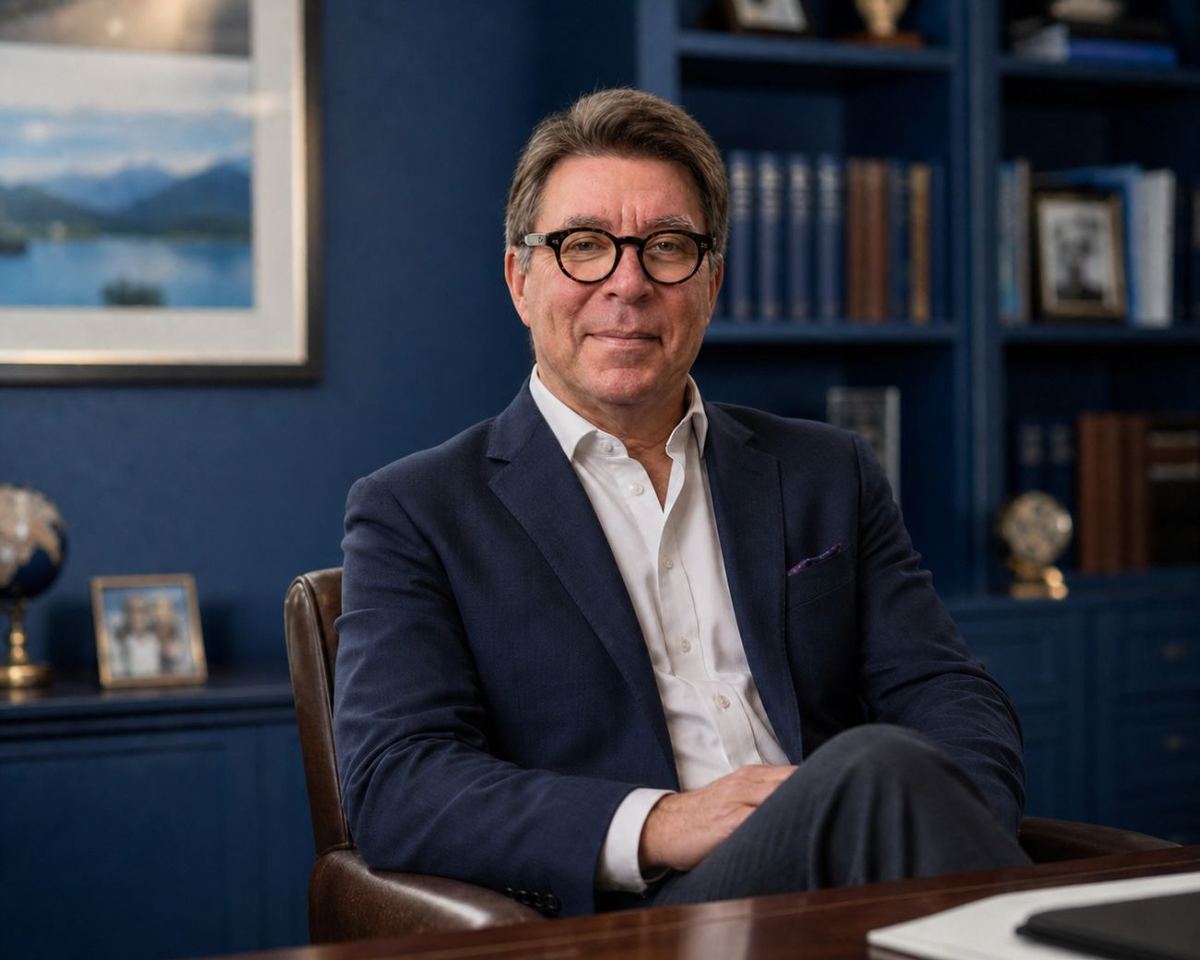
I came to finance by accident, and as a linguist. I studied languages and literature. In the summer of 1987 I took a trainee position with an American bank in Munich, some two months before the October “Black Monday” crash. I have been inside the world of money and capital ever since, as an adviser, an investor and a participant in operating businesses. What kept me there was the discovery that numbers are a language, with their own grammar and syntax, and that once you can read them they tell the story of how societies prosper and decay.
I have always read widely across history, economic theory, social and political philosophy, culture, and of course finance and business, and I subscribe to the concept of investing as the ultimate liberal art. I read not to time markets but to understand the water in which we swim: social mood, and changes in what societies consider normal. My own lens is the Austrian School. Mises and his successors taught me to see the insidious effects of inflationary monetary policy and uncontrolled debt-funded spending on life, culture and wealth creation. They also taught me to see the undermining of the bourgeois morality that places time preference, saving and sound money at the heart of economic prosperity and social flourishing. Ben Franklin’s ‘doing well by doing good’ has long been a favorite motto.
Over the last 25 years I have watched central banks intervene ever more aggressively, and governments spend increasingly more on wars and entitlements. What is uncertain is when and how it breaks, and, crucially, what happens afterwards. The convergence of the long cycles suggests the next downturn will arrive at a time of heightened social fragility, so its effects may reach far wider than anything in living memory.
I am convening the Turning Circle to discuss the issues I see, to test my thinking and the robustness of the hypothesis I see unfolding with a small group of intelligent practitioners in business and investing, with generational personal responsibilities and time horizons that extend well past institutional norms, and to work out together where the ball might travel on its second and third bounces.
Sir Steven Wilkinson KCNG is the founder and managing director of Good & Prosper, a private investment and advisory group founded in 1998, based in Germany and Ireland and active in the United States and Europe. He writes the Pitchfork Papers on Substack.
How it works
The founding year
A monthly session
We meet live online each month, timed for members in America and Europe, with everyone on their own screen so the room can see one another. I bring what I have been reading and where my thinking has moved, and members bring the decisions in front of them and their perspectives and questions.
Lectures given exclusively to the Circle
Every other month, a thinker or published author with deep expertise in one of the cycles joins us, lectures, and takes our questions.
Reading and papers
I select the reading for each session. Along the way we publish papers, for members only, capturing the Circle’s evolving thinking, and I write for members between sessions.
Two gatherings in person
We meet twice a year in person, once in Europe and once in America, in April and November. The gatherings are optional and priced separately at cost.
The next generation in the room
Principals are encouraged to bring their children or grandchildren (aged 18 and over) as Next Generation members. The young often hear their parents best through other parents, and the conversation between the generations is part of what the Circle is for.
The room
Between sessions, members continue the conversation in our private community, and I make personal introductions to the people most relevant to each member’s situation.
Membership
Twenty-five principals, and the generation behind them
The Turning Circle is priced in gold. A year costs 12 ounces. That is a statement about everything we will discuss, and it means the price holds its value whatever happens to the dollar.
| Membership | Paid upfront (save ~15%) | Monthly plan |
|---|---|---|
| Principal | 12 oz gold ($48,736) | 14 oz over the year ($4,738 a month) |
| Next Generation | 2.5 oz gold ($10,153) | 3 oz over the year ($1,015 a month) |
Dollar amounts at a gold price of $4,061 an ounce.
Next Generation membership is for a principal’s children or grandchildren. Colleagues and spouses join as principals.
You may pay in gold coins, American Eagles, Canadian Maples or Krugerrands, and we will arrange it through our brokerage account at SchiffGold. Or you may pay the dollar equivalent by bank transfer, at the day’s gold price.
Membership begins with a 12-month commitment. After the first year it continues on the monthly plan, with 30 days’ notice to stop, and you may prepay the next year at any time. There is no enrollment fee. Every member receives a welcome from me and a dossier of key reading and links.
The first session is in late January 2027. Join by January 20 to be part of it. Everyone who joins during the founding year, through June 2027, is recognized as a founding member of the Circle.
Join
How to join
Most members come by introduction, through the advisers and networks around Good & Prosper and through my own. If no one has introduced you, apply below. I speak with every principal before they join, and Next Generation members join through their principal.
When all 25 principal seats are taken, new applicants go on a waiting list. When a seat opens, it is offered to the list for 48 hours.
- 1
Apply below
Tell us about the business or capital you are responsible for, what you want to think through, and who introduced you.
- 2
A conversation
If it looks like a fit, we will arrange a 30-minute call.
- 3
Invitation
Invited principals choose monthly or annual payment, add any Next Generation members, and receive their welcome.